
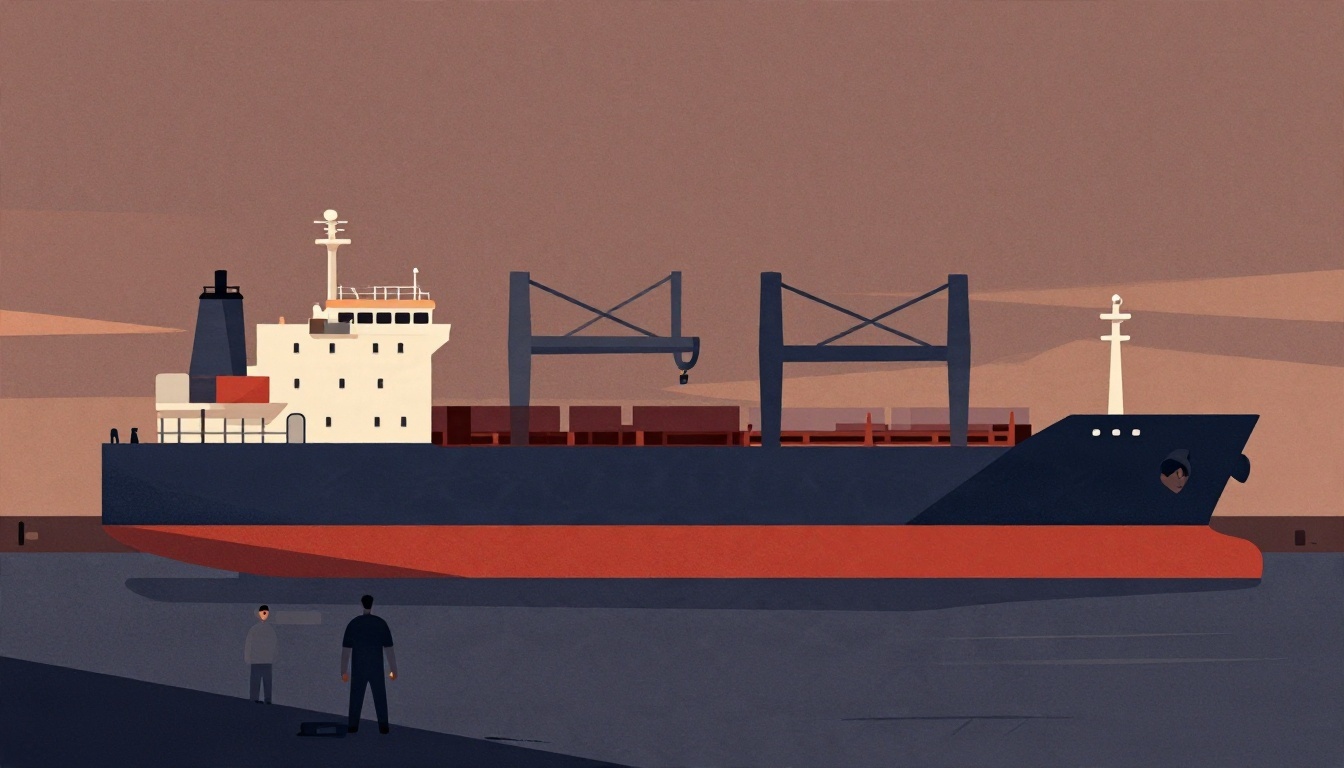
Under FOB, CFR, and CIF Incoterms 2020 rules, at what point does risk of loss pass from seller to buyer?
Select one answer.
Why bulk cargo risk usually starts with the wrong three letters
If you buy or sell bulk commodities — grain, edible oils, petroleum products, jet fuel — the single most expensive mistake you can make is treating the Incoterm as a formality. Incoterms are the eleven three-letter rules published by the International Chamber of Commerce (ICC) that define who arranges and pays for transport, at what point risk of loss or damage passes from seller to buyer, and who handles export and import clearance, according to inecta's Incoterms 2020 guide.
They do not cover price, payment method, or when title transfers. Those belong elsewhere in the contract. Get the Incoterm wrong and you can be legally responsible for cargo you no longer control — or paying freight you thought the seller had covered.
The four sea-only rules that matter for bulk
Incoterms 2020 splits its eleven rules into two families. Seven apply to any mode of transport (EXW, FCA, CPT, CIP, DAP, DPU, DDP). Four are written specifically for sea and inland waterway transport, and these are the ones that suit bulk and break-bulk shipments loaded directly onto a vessel: FAS, FOB, CFR, and CIF.
Here is how the three most common bulk rules actually split cost and risk:
- FOB (Free On Board): The seller delivers the goods on board the vessel at the named load port and clears them for export. Risk and cost transfer to the buyer the moment the cargo is loaded. The buyer arranges and pays ocean freight and insurance, and nominates the vessel. See CommoFlow's FOB explainer.
- CFR (Cost and Freight): The seller pays the freight to the destination port, but risk still passes to the buyer at loading. The buyer arranges insurance.
- CIF (Cost, Insurance and Freight): The seller pays freight and insurance to the destination port, but risk transfers at the same point as FOB — once the goods are on board. This is the detail buyers miss most often, per Elysium Agri's comparison.
The critical takeaway: under FOB, CFR, and CIF, risk passes at the load port, not at the destination. If you are the buyer, you own the risk for the entire ocean voyage even when the seller arranged the ship.
The container trap that costs bulk buyers money
FOB, CFR, and CIF deliver on board the vessel. But if your cargo moves in a container, the seller hands it over days earlier at an inland terminal. In that gap, the seller legally bears risk for something it no longer controls. The ICC expressly advises against using FOB, CFR, and CIF for containerized cargo; FCA is the better fit. One legal analysis notes that in 54 percent of reviewed FOB, CFR, or CIF transactions, goods actually moved in containers — against ICC guidance. For true bulk (grain, liquid cargo, break-bulk), the sea-only rules remain appropriate.
Laytime, demurrage, and the clause most contracts forget
For bulk cargo, the Incoterm alone is not enough. You must also agree on laytime (the free time allowed for loading and unloading) and demurrage (the daily charge when that time is exceeded). If the vessel arrives outside the agreed laycan, or loading runs past the agreed laytime, demurrage accrues — and who pays depends on terms the contract must set out explicitly.
Under FOB, the buyer nominates the vessel. Nominating late, or nominating a vessel the load port cannot accommodate, creates delay the buyer usually pays for. Under CIF or CFR, the seller controls the vessel, so the laytime and demurrage split needs even clearer drafting.
A practical checklist before you sign
- Name the edition. Write "CIF Rotterdam (Incoterms 2020)," not just "CIF Rotterdam." The year matters.
- Name the port. "FOB" alone specifies nothing usable. "FOB Jebel Ali" and "FOB Bandar Abbas" describe different obligations and costs.
- Match the rule to the mode. Bulk and break-bulk: FOB, CFR, or CIF. Containerized: FCA.
- Confirm where risk passes. Under FOB, CFR, and CIF, risk transfers at the load port. Buy marine cargo insurance from that point, not from destination.
- Draft laytime and demurrage explicitly. State the free time, the demurrage rate, and who pays.
- Check insurance cover level. Under CIP, Incoterms 2020 requires top-grade (Institute Cargo Clauses A) cover; under CIF, minimum cover applies by default.
- Separate title from delivery. Incoterms do not govern when ownership transfers. Address that in the contract.
Quick quiz: test your Incoterms knowledge
Before you apply this to your next bulk contract, check one fact that trips up most buyers.
Under FOB, CFR, and CIF, at what point does risk of loss pass from seller to buyer?
- A) When the cargo arrives at the destination port
- B) When the cargo is loaded on board the vessel at the load port
- C) When the buyer takes physical possession at the warehouse
If you answered B, you have the core principle right. Risk passes at the load port under all three rules — even under CIF, where the seller pays freight and insurance to destination.
How the Featured Expert Can Help
Mindmingle is a commodity trading platform that connects buyers with high-value commodities such as petroleum, soybean oil, sugar, and jet fuel at manufacturer prices. It offers bulk purchasing options and aims to streamline wholesale operations for distributors and wholesalers worldwide. If you are sourcing bulk commodities and want to align your Incoterms strategy with your procurement, visit Mindmingle.